About Indonesia

Geography
In addition to cultural and religious diversity, Indonesia is also incredibly geographically diverse. As an archipelagic country, the ocean is always relatively close by and Indonesia is particularly well-known for its gorgeous beaches. That being said, the country is also home to many mountains, rivers, lakes, densely jungled areas, and active volcanoes; the latter being one of the main contributors to the incredibly agriculturally fertile land in the country.
Population
The population of Indonesia is over 260 million, half of which lives on Indonesia’s largest island, Java. Indonesia is a very ethnically diverse country with at least 300 native ethnic groups. The largest ethnic groups are the Javanese, the Sundanese, ethnic Malays, and the Madurese. The Chinese-Indonesians also make up an important and influential ethnic minority. There is also a strong sense of patriotism among the Indonesian people, despite their cultural heritage, which group they belong to, and which region of the large country they hail from.
Religion
Indonesia is incredibly religiously diverse. Despite the constitutional right to religious freedom, the government only recognizes six religions practiced within the country: Islam, Protestantism, Roman Catholicism, Hinduism, Buddhism, and Confucianism. 87.2% of the country practices Islam, making Indonesia the largest Muslim-majority country in the world. Though they are not as widely practiced in present day Indonesia, Hinduism and Buddhism have greatly impacted the history of the country in terms of history, beliefs, architectures, and culture. Though they are not recognized by the government, there are hundreds of indigenous religions that are practiced throughout the country as well.
Politics
After several years of political tumult, Indonesia established its democracy as a multi-party system in 1999. Since then, there have been two legislative elections, neither of which led to one political party winning a majority of seats. This has resulted in coalition governments.
Economy
Indonesia has a mixed economy in which both private sector and government play important parts. The country has the largest economy in Southeast Asia and is a member of the G-20 major economies. Indonesia’s GDP is $936.955 billion, in PPP terms the GDP is $3.010 trillion. The country’s currency is called the Rupiah and there are approximately 13,505 Indonesian Rupiah to one US Dollar. The service, agriculture, tourism, trade, and industry sectors play the most important roles in Indonesia’s economy.
Customs & Traditions
With over 300 ethnic groups, a great deal of foreign influence, and a long troubled history, over the years, Indonesia has managed to develop and retain one of the most diverse cultures in the world. The concept of “saving face” is very important in Indonesia, meaning that Indonesian people are very careful about how they speak and interact with others. In general, try to be polite and soft-spoken when traveling through the country and you should be treated warmly. Greet people formally with a handshake and the word “Selamat”. In more touristy areas, the locals are used to the presence of westerners, their tendencies, and their habits. However, the further you travel out of the big cities and away from tourist destinations, the more you should practice modesty in the way you act and the way you dress (the latter is especially important for women).
Climate
Divided by the equator, the climate of Indonesia is almost completely tropical and temperatures tend to remain constant, though they do vary based on the geography of the region. Though the temperature and daylight hours are relatively reliable and consistent throughout the year, the rainfall can be somewhat erratic. Humidity ranges from 70-90% with gentle and predictable wind patterns. Monsoons come in from the south and east from June-September and from the northwest in December-March.
Food & Drink
Indonesian food is delightfully flavorful, varied, and exciting. Due to the diverse population and culture, the food is also diverse and can vary greatly from region to region. Like most other Asian countries, rice is a staple and is usually served with meat, fish, or vegetables as a side. Chili, coconut milk, lemongrass, galangal, garlic, turmeric, and ginger are flavors commonly found in Indonesian cuisine. Popular dishes include nasi goreng, gado-gado, sate, and soto. The national dish is tumpeng. Avoid drinking tap water in Indonesia and opt for bottled water instead, it will be available anywhere you go.
News & Magazine
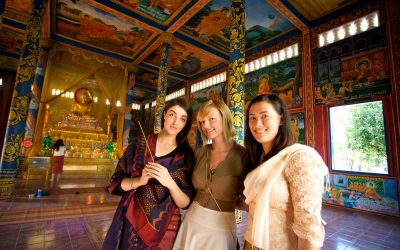
Things for Women to do In Southeast Asia
Groups of women travelers in Southeast Asia have fast become the norm. There are tours and trips which cater specifically for women, but we find that women are just as likely to do similar things to men. Most women may substitute an afternoon in the spa instead of...

The Trails of the Khmer Rouge
The Khmer Rouge were the ruthless followers of the Pol Pot who controlled Cambodia from 1975 to 1979. They were responsible for the deaths of more than 2 million Khmer people and then after the mass genocide they led Cambodia into a brutal civil war which lasted for...

Take a Trip in the Mekong Region – Southeast Asia
Visit the exotic countries of Myanmar, Laos, Thailand, Cambodia, and Vietnam. Southeast Asia has a lot of offer and these five largely Buddhist countries share many similarities but are also very different in their own unique way. Myanmar Myanmar is a very popular...
We are a registered tour company based in Southeast Asia. Our goal is to provide travelers the safe way to travel, feel warm, reliable and meet the right locals! More about AAT, here you are https://adventureasiatravel.com/about/ at the bottom